
As part of our continuous efforts to enhance the quality of teaching–learning and overall departmental development, we are compiling a list of innovative practices implemented in the department.
We kindly request you to share your valuable feedback and suggestions regarding innovative initiatives/practices that can help improve academic delivery, student engagement, research activities, industry interaction, and overall departmental functioning.
Your inputs will help us strengthen our practices and align them with quality improvement initiatives.
Kindly share your feedback:
Innovative Teaching Learning Practices :
To enrich students’ learning experiences beyond the conventional classroom practices, the department of E&TC adopts various innovative teaching-learning methodologies. The primary objectives of these initiatives are to:
- Improve the overall quality of learning by integrating creative and contemporary teaching approaches.
- Enhance student’s understanding and competency in applying innovative techniques and learning strategies.
- Broaden student’s exposure to emerging technologies and current global as well as societal challenges.
- Foster creative thinking and problem-solving abilities through active engagement in various interactive activities.
List of Various Innovative Teaching–Learning Activities
| S. N. | Activity | Objective | Statement of Clear Goals | Use of Appropriate Methods | Significance of Results | Effective Presentation | Reflective Critique | Mapped POs |
| 1 | Think–Pair–Share | Develop conceptual understanding and communication | Goals clearly defined for collaborative learning | Active learning, peer discussion | Improved understanding & teamwork | Students present answers | Reflection after discussion | PO2, PO3, PO9, PO10, PO12 |
| 2 | Flipped Classroom | Promote self-learning and problem solving | Pre-class and in-class goals defined | Videos, digital content, discussion | Better critical thinking | Classroom problem solving | Feedback after activity | PO1, PO2, PO9, PO10 |
| 3 | Mind Map | Improve conceptual clarity | Topic summarization goal defined | Visual mapping technique | Better retention & analysis | Diagram presentation | Self-evaluation of map | PO1, PO2, PO9, PO10, PO12 |
| 4 | Learning through Success Stories | Connect theory with real applications | Goal to relate concept with real case | Case study, peer discussion | Increased motivation | Group sharing | Reflection on learning | PO1, PO2, PO3, PO5, PO8, PO9, PO10, PO12 |
| 5 | Student Research Presentation | Develop research & communication | Goal to analyze research papers | Paper review, presentation | Improved analytical skills | PPT / seminar | Peer & teacher feedback | PO1, PO2, PO8, PO9, PO10, PO12 |
| 6 | Virtual Lab | Provide practical exposure | Goal to simulate experiments | Simulation tools | Better experiment understanding | Lab report / demo | Self-analysis | PO1, PO2, PO5, PO9, PO10, PO12 |
| 7 | Crossword Puzzle | Reinforce terminology | Goal to recall concepts | Puzzle activity | Better memory retention | Answer discussion | Reflection on errors | PO1, PO2, PO3, PO9, PO10 |
| 8 | Google Classroom | Digital learning support | Goal to enable continuous learning | Online platform | Improved participation | Assignments / posts | Feedback comments | PO5, PO10, PO12 |
| 9 | Word Maze | Improve concept recall | Goal to identify key terms | Puzzle solving | Enhanced engagement | Solution sharing | Self checking | PO1, PO2, PO3, PO9, PO10 |
| 10 | YouTube / Blended Learning | Support self-paced learning | Goal to enhance understanding | Multimedia + discussion | Better comprehension | Video + class discussion | Reflection notes | PO1, PO2, PO6, PO10, PO12 |
| 11 | NPTEL | Learning beyond syllabus | Goal to improve knowledge | Online course | Advanced understanding | Certificate / report | Course feedback | PO2, PO3, PO12 |
| 12 | Spoken Tutorial | Develop software skills | Goal to learn tools | Guided tutorials | Practical skill gain | Demo / output | Practice review | PO1, PO2, PO3, PO4, PO5, PO9, PO12 |
| 13 | Field Visit | Industry exposure | Goal to observe real system | Visit + report | Practical knowledge | Report / presentation | Reflection report | PO1, PO2, PO6, PO7, PO9, PO10, PO11, PO12 |
| 14 | Hands-On Session | Develop practical skills | Goal to perform experiment | Lab / tools | Skill improvement | Demonstration | Learning review | PO1, PO2, PO5, PO8, PO9, PO10, PO12 |
Title:-Think Pair Share
The Think–Pair–Share (TPS) technique is an active learning strategy implemented to enhance student engagement and problem-solving abilities. In this method, students first think individually on a given question or problem, allowing them to develop independent reasoning and critical thinking. They then pair up with a peer to discuss and compare their ideas, which facilitates communication, collaboration, and peer-to-peer learning. Finally, each pair shares their consolidated responses with the larger class, promoting collective understanding and active participation. The practice encourages students to articulate their ideas confidently, engage in academic discussion, and refine their conceptual clarity. As a result, TPS effectively improves problem-solving skills, strengthens individual reasoning, enhances teamwork and communication, and boosts confidence in public speaking, thereby contributing significantly to outcome-based learning.
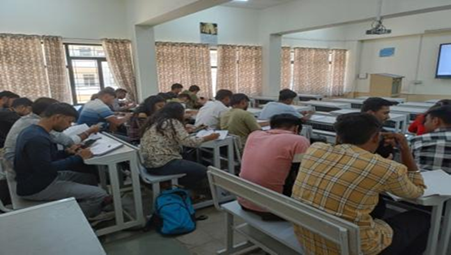
Think Pair Share Activity conducted for BE E&TC class.
Title:-Flipped Classroom
The Flipped Classroom is an instructional strategy in which the traditional teaching sequence is reversed to enhance student engagement and application-based learning. Instead of learning new content during class time, students first explore foundational concepts independently through pre-class materials such as video lectures, readings, recorded lessons, or online learning modules. This allows them to study at their own pace and come to class with prior exposure to the topic. Classroom sessions are then utilized for higher-order, interactive learning activities including group discussions, collaborative tasks, and problem-solving exercises. This approach maximizes active participation and provides opportunities for deeper conceptual understanding through peer and instructor interaction. As a result, students demonstrate improved engagement, better application of concepts, and enhanced participatory learning skills, contributing effectively to outcome-based education.

Flip-Classroom activity conducted for TE E&TC Class
Title:-Mind Map
A Mind Map is a visual learning strategy used to organize information in a structured and interconnected manner, beginning with a central concept from which related subtopics branch outward. This technique helps students visually link key ideas, enabling better understanding and recall of complex topics. The goals of implementing mind mapping include visually summarizing an entire topic in a single, easy-to-understand layout, enhancing conceptual clarity by representing relationships between ideas, promoting active learning through student-created content, and fostering higher-order thinking skills such as analysis, organization, and synthesis. It also encourages creativity by allowing students to use keywords, and diagrammatic branches. In practice, after completing a chapter or concept, the teacher introduces the purpose of mind mapping and guides students to list key points, formulas, definitions, and related concepts. Students then organize this information into a mind map structure to connect ideas meaningfully. This practice leads to improved summarization skills, deeper conceptual understanding, and enhanced active learning, thereby supporting outcome-based education
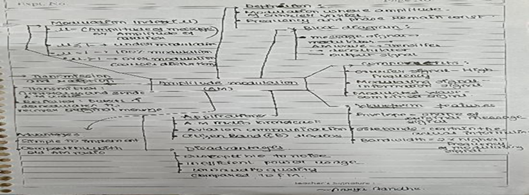
Mind Map activity conducted for SE E&TC Class
Title:- Learning through Success Stories
In Learning Through Success Stories Methodology Students explore the satellites designed by students of elite organizations such as COEP, IITB to understand the end-to-end design and development of the picosatellite under the mentorship of ISRO. Peer discussion and relate the course content to the project using this methodology students Exploring the satellites designed by student community from IIT Bombay & COEP, Pune not only give the end-to-end design cycle but also truly inspire and motivate the students to work on core engineering concepts. Knowledge of impact of environment and sustainability issues related to the design.

Learning through Success Stories activity conducted for BE E&TC Class
Title:- Student-Led Research Paper Presentations
Student-Led Research Paper Presentations are conducted to develop student’s ability to independently explore, analyse, and communicate advanced technical content through active engagement with research literature. The primary goals of this activity are to promote independent learning by encouraging students to read, understand, and interpret research papers on their own; to enhance critical thinking and analytical skills by evaluating research methodologies, results, and findings; and to strengthen scientific communication skills through structured presentations. In this practice, students are assigned to select and review recent research papers from reputed journals on a specific topic provided by the teacher. Each student group presents their paper in class, focusing on the problem statement, methodology, major findings, and relevance to current industry or academic practices. This activity results in improved ability to interpret and articulate complex technical concepts, greater exposure to emerging research challenges and increased motivation for independent reading and analysis beyond the prescribed syllabus, thereby contributing effectively to outcome-based learning.

Student-Led Research Paper Presentations Conducted for BE E&TC Class
Title: -Virtual Lab
Virtual Lab is an innovative digital learning tool that provides students with a simulated environment to perform experiments, analyze results, and understand technical concepts without the limitations of physical laboratory resources. The primary goals of using Virtual Labs are to enhance conceptual understanding by allowing students to repeatedly perform experiments at their own pace, to provide access to advanced simulations that may not be feasible in a traditional lab setup, and to strengthen analytical and problem-solving skills through interactive, technology-enabled experimentation. In practice, students are assigned specific experiments through the Virtual Lab platform, where they follow structured procedures, observe simulated outcomes, and record their observations. Faculty guide students in interpreting results and relating them to real-world applications. This approach enables continuous learning and reinforces practical skills even outside the physical lab environment. The use of Virtual Labs results in improved visualization of complex concepts, better preparedness for physical lab sessions, enhanced confidence
Virtual Lab Activity Conducted for SE E&TC Students
Title: -Crossword Puzzle
Crossword Puzzle is an engaging and interactive learning tool used to reinforce key terminologies, concepts, and definitions in a fun and stimulating manner. It helps students recall information, strengthen conceptual understanding, and enhance memory retention through an enjoyable problem-solving activity. The primary goals of introducing crossword puzzles in teaching–learning are to promote active recall of subject-related terms, improve vocabulary and concept clarity, and make learning more interactive and stress-free. In practice, students are provided with a crossword puzzle based on the topic taught in class, containing clues related to important definitions, formulas, block diagrams, or technical terms. Students attempt the puzzle individually or in small groups, encouraging critical thinking and collaborative learning. The teacher later discusses the correct answers, clarifies misconceptions, and connects the terms back to the lesson content. This method results in improved retention of core concepts, enhanced engagement with course material, better reinforcement of terminology, and increased motivation to learn, thereby contributing effectively to outcome-based education.

Crossword Puzzle activity conducted for SE E&TC Class
Title: -Google Classroom
Google Classroom is an innovative teaching method that enhances digital and blended learning by providing a centralized online platform for sharing study materials, assignments, and announcements. It improves student engagement through interactive features, supports continuous assessment with online quizzes and instant feedback, and promotes collaborative learning using integrated tools like Google Docs, Slides, and Google Meet. This method increases student participation, streamlines evaluation, strengthens communication, and develops digital competencies while enabling flexible, anytime–anywhere learning.
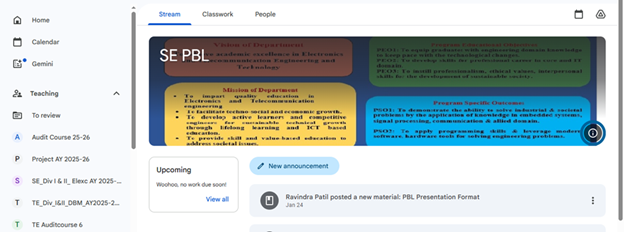
Google Classroom for SE E&TC Class
Title: – Maze Word
The Word Maze activity was conducted for BE E&TC students in the course VLSI Design and Technology to enhance conceptual understanding of VHDL terminology and VLSI concepts. In this activity, students were provided with a word maze puzzle containing clues related to key VHDL terms such as data types, sequential statements, loops, and conditional assignments. Students were required to identify and locate the correct technical terms within the maze based on the given clues. This activity promoted active learning, improved technical vocabulary, and strengthened concept recall in an engaging and interactive manner. It also encouraged analytical thinking and student participation, making the learning process more effective compared to conventional methods.
Maze word for BE E&TC Class
Title: -NPTEL
NPTEL is an innovative learning initiative by IITs and IISc Bangalore that promotes self-paced, technology-enabled learning. It integrates online video lectures, assignments, and certification courses into the academic curriculum, allowing students to learn from expert faculty beyond the classroom.This approach enhances conceptual clarity, independent learning, and industry readiness, making it an effective blended and student-centric teaching–learning practice.

Title: -Spoken Tutorial
The Spoken Tutorial Project is an initiative by Indian Institute of Technology Bombay that provides short, self-paced video tutorials for learning software and programming skills.It promotes independent learning, skill development, and practical knowledge using open-source tools.This initiative supports innovative teaching–learning by enhancing students’ technical competency and employability.

Title:-Field Visit
A field visit aims to provide practical exposure by connecting theoretical knowledge with real-world applications. It helps students understand industry practices, processes, and working environments. Additionally, it enhances observation skills and offers insight into career opportunities.

Title:-Hands On Session
A Hands-On Session is an experiential learning activity where students actively perform tasks, experiments, or use tools to gain practical knowledge. It enhances conceptual understanding, problem-solving skills, and technical competency through direct application. This method supports active learning and skill development, making students industry-ready.

Title: – Blended Learning using YouTube videos
YouTube videos that highlight current trends and future technological developments. In practice, teachers assign pre-class activities, including viewing instructional videos and related digital content on credible platforms. These materials are later discussed in the classroom to promote deeper comprehension, critical thinking, and active participation. This blended approach supports diverse learning styles and strengthens student’s engagement with the subject matter, contributing effectively to outcome-based learning.

YouTube Video
List of YouTube Links created and shared by the faculties of the department.
Please provide your valuable feedback using following link:
 ACAP Round PCM Final Merit List (2026-27)
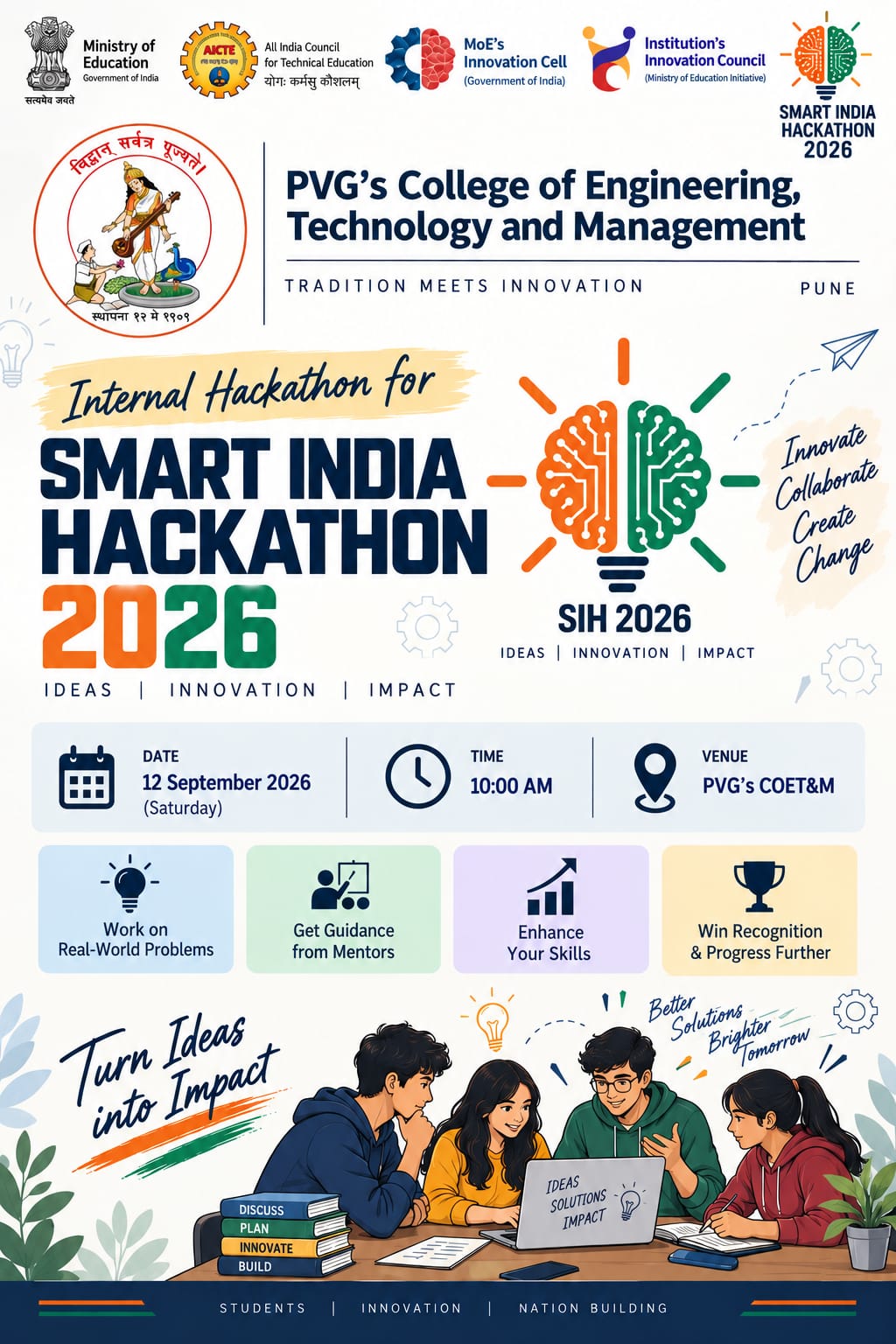 Internal Hackathon organized for SIH 2026.